

Why Some Yarns Bloom and Others Just Don't
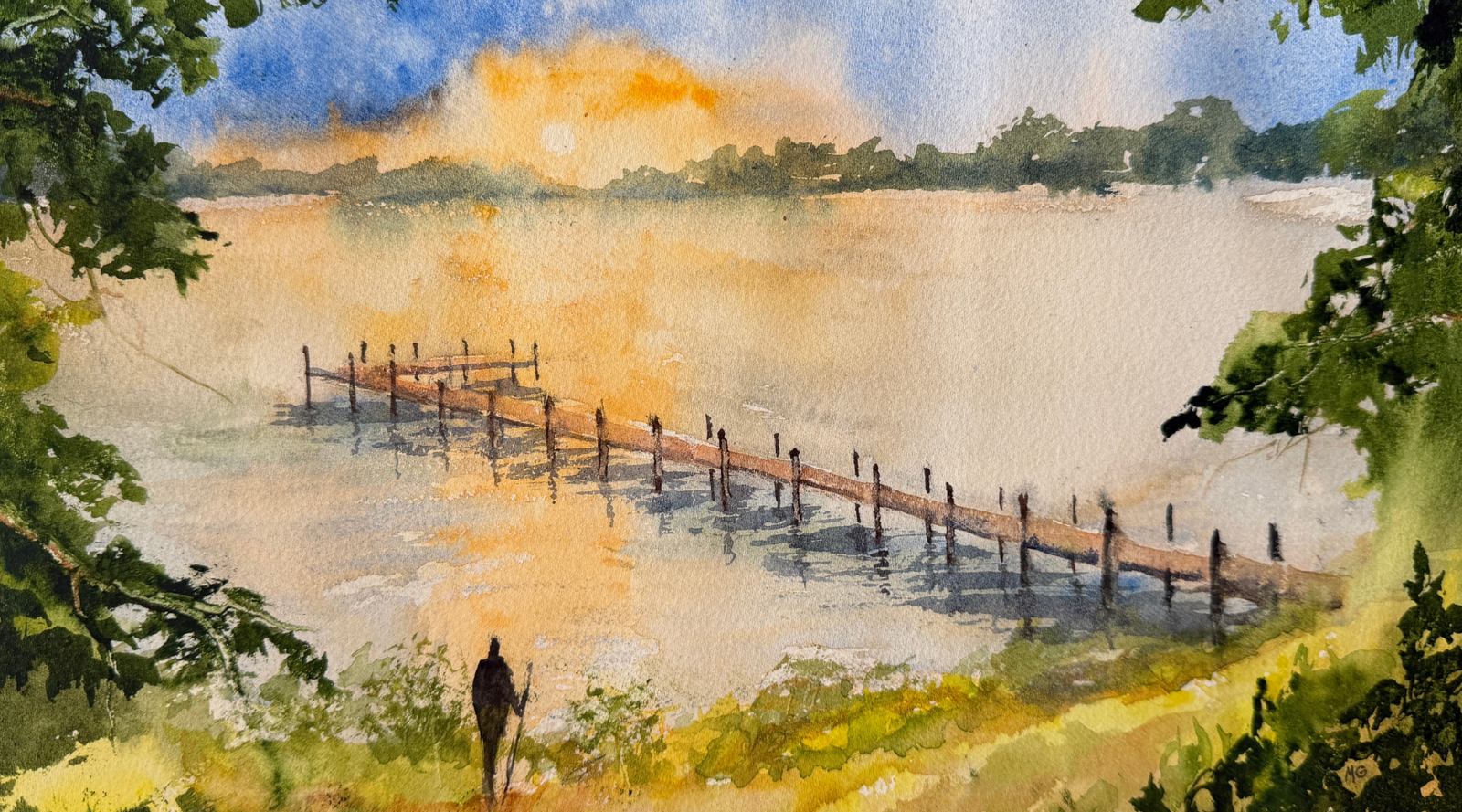
My cousin Colleen came to the retreat last month, and she brought her husband Matt along and stayed with us for a few days. Matt is an award-winning photojournalist, but what he loves most is plein air painting. He set up in various spots and did three beautiful watercolors of sites around Leonardtown.

Painting by Matt Gentry -- more of his work on Instagram.
He was telling me about how different watercolor is from oil -- how it dries light. If the color is right the moment you put it on the paper, it will be wrong by the time it dries. I mentioned that knitters experience something similar in blocking, how you don't really know what some yarns will look like until you've applied water to them. He looked up and said, "Isn't it interesting, the effect water has on both our media." Indeed.
Water makes his paints darker and can mislead the artist. For knitters, water is what reveals a yarn's true nature.
Woolen spun yarn changes the most of anything you'll ever block. I blocked a woolen spun swatch two ways: a quick steam, and a full wet soak. After steaming, there was no significant change to the surface or the stitch definition -- just a subtle bloom.

It wasn't until I gave the same swatch a real soak that the fibers actually let go. They realigned themselves so thoroughly that I could hardly tell one stitch from the next. . After an over night dry, none of the swatches had changed in size from pre-blocking but the surface transformation of the woolen spun yarn was dramatic.

Steam gets you partway there without costing you stitch definition. A real soak gets you all the way there, and the definition is the price you pay for it. Not every woolen spun yarn will transform quite this dramatically, but many will come close -- which is worth knowing before you decide to handwash a woolen spun garment where you're hoping the stitch pattern stays crisp. I'm not a big fan of dry cleaning handknits as a rule, but for a piece where the stitches are meant to be the star of the show -- a heavily textured or cabled woolen spun sweater, say -- dry cleaning really is the way to go.
non super wash Woolen spun yarn swatch before and after blocking
Worsted spun yarn can blooms too, just very modestly. Because the fibers were combed and aligned before spinning, they already have more order to them going in -- so there's less room for water to rearrange things. It can still fill in and softens with blocking, just not as dramatically as woolen spun does.

non superwash worsted spun yarn swatch before and after blocking
Knowing what your yarn will do just means you're choosing that outcome on purpose, instead of being surprised by it after the fact.
Superwash wool has a polymer coating that glues down the wool's scales so it doesn't felt in the washing machine. This means that it will bloom the least of all. All wool is prone to stretching during blocking, and superwash especially so. Great if it's a lace shawl. Not so much if it's a sweater.
None of that means blocking is optional for superwash, though. Fiber bloom and stitch evenness are two different things. Blooming depends on the fiber -- woolen spun does it the most, worsted spun does it modestly. But evening out your stitches is something blocking does for nearly every fabric, superwash included. Water lets uneven tension settle into place and lets your stitches sit where they're supposed to, whether or not the fiber itself has any bloom in it. So a superwash sweater still needs to be blocked -- just gently.
I often say, "Whatever the question, the answer is always, you'll have to swatch it and see." Clara Parkes agrees and addresses blocking clearly in The Knitter's Book of Yarn: the only real way to know what a yarn will do is to swatch it, wash it, and let it tell you. That's still the truest thing anyone can say about blocking. You can't know what you have until the water's done its work -- in a painting, or in a sweater.
Warmly,
~Ellen