
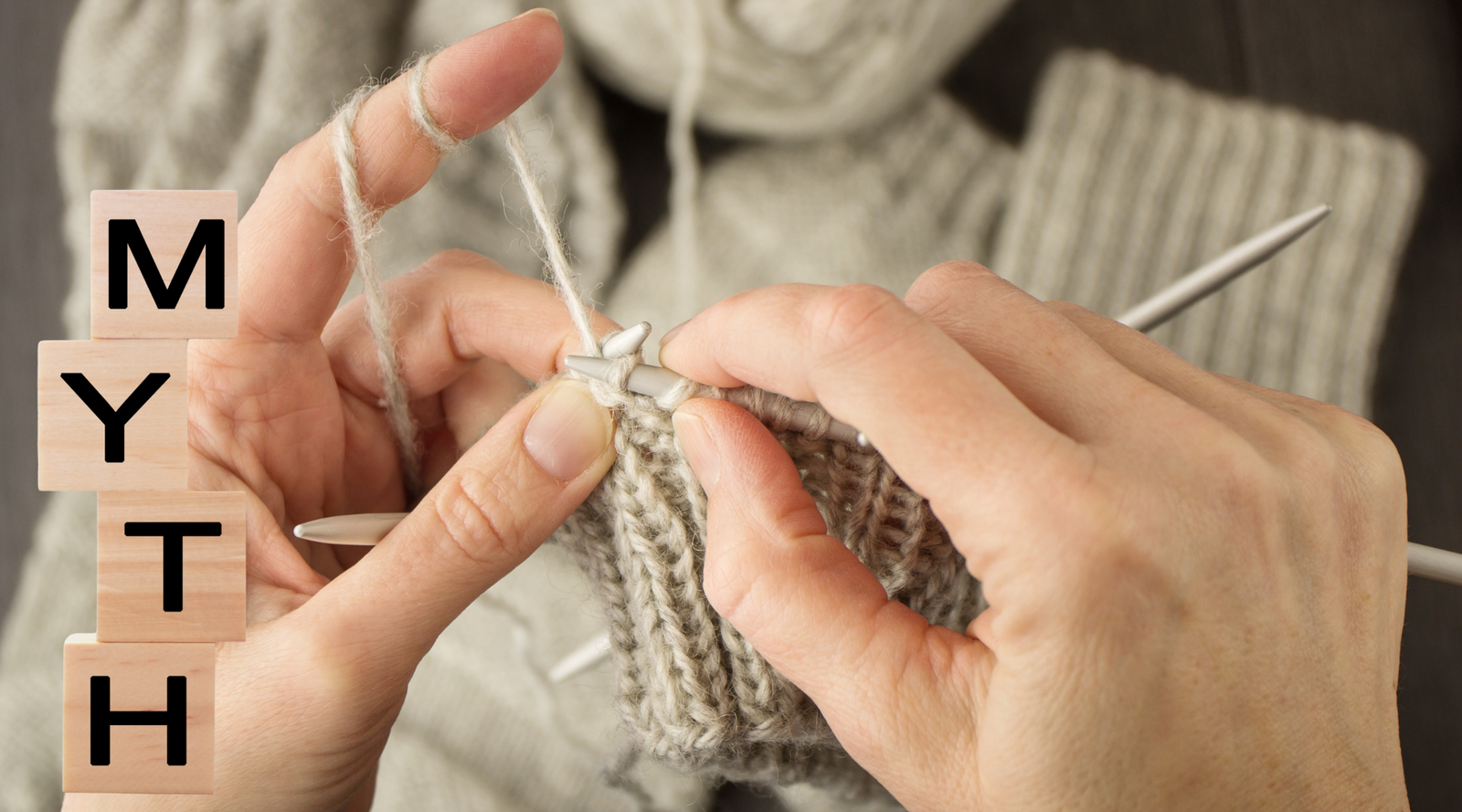

The thing about myths is that they usually start with a kernel of truth. Sometimes they’re mostly true, sometimes they’re only true in certain situations, and sometimes they’re just plain outdated. But they always sound convincing—and in the knitting world, they get repeated so often they can feel like unshakable fact.
Everyone has their own truth. Designers, teachers, and “experts” on the internet all speak from their experience, but that doesn’t mean their truth has to be yours. I used to tell my kids to question authority—even if it’s mine—and I think that applies to knitting too.
So let’s do some gentle myth-busting. In this post, I’ll share a handful of common knitting “rules,” where they came from, and whether they’re really worth following. Some are helpful guidelines, some are situational, and some are just unnecessary stress.
Myth 1: You always have to swatch in the round if you’ll knit in the round
Not true. Swatching in the round is only necessary if you struggle with “rowing out” (knitting tighter on one side than the other). For most knitters, a flat swatch will give you an accurate enough gauge. Don’t let this myth discourage you from swatching or starting your project.
Myth 2: There is one best cast on
There are lots of ways to cast on, and while some, like long-tail cast on, are super versatile and good in most situations, it is not always ideal. Sometimes you want a firmer edge (like on back necklines and shoulders) and sometimes you want more stretch (think lace or cuffs.) Learning a few different cast ons will give you more control over the finished look and functionality of your projects.
Myth 3: Blocking can fix everything
Blocking is powerful, but it’s not magic. It can’t make a bind off looser, and it won’t shrink your garment if it’s too big. Blocking enhances stitch definition, opens lace, and smooths fabric, but it won’t fix fundamental fit issues. Think of blocking as the finishing touch, not the solution to everything.
Myth 4: Plant-based yarns are hard to work with
Plant-based fibers like cotton, linen, and bamboo behave differently from wool, but that doesn’t make them “bad.” They lack elasticity, so they can feel harder on the hands, but there are high quality cottons and modern construction linens that have a great hand. Learning to work with plant-based yarns is worth the effort for the cool, breathable garments they give you.
Myth 5: Swatching is just for checking gauge
Swatching tells you more than stitch counts. It helps you get comfortable with the yarn, test complicated stitch patterns on a small scale, and see how the fabric behaves after blocking. Treat your swatch as a learning tool, not just a gauge check.
Myth 6: A 4x4 swatch guarantees your gauge
We knit differently when swatching compared to when we knit an actual project. A small swatch might be accurate in theory, but once you’re working a full garment, your tension can change. A larger swatch—at least 6x6 inches—gives a better picture. And if you knit on the sofa while binging on your favorite show, that's where you should swatch. And give your swatch the blocking method you plan to use when you block the finished garment to see if you can't just ease that tension out a smidge without going up a needle size.
Myth 7: You can substitute any yarn if the gauge matches
Just because you can get gauge with a certain yarn, doesn't mean you should use that yarn. Gauge is only part of the story. Fiber content, construction, and drape all play a role, as does the physical weight of the yarn. The nature of the yarn determines how much it curls and whether or not you need a border on the fabric, and lots more. Always consider the nature of the yarn you're replacing and why that yarn was chosen.
The takeaway
Knitting is full of advice, traditions, and yes—myths. Some are helpful shortcuts, some are rooted in a specific problem, and some are just habits that stuck around longer than they should have. The key is to look at them with curiosity, not pressure. Try them, test them, and see if they serve you in your knitting.
At the end of the day, knitting isn’t about following every rule perfectly—it’s about creating pieces you love, with a process that feels good along the way.
I’ll be chatting more about these myths (and a few others!) in my YouTube Live this Wednesday. Come join the conversation, share your experiences, and let’s bust some myths together.
Kathy Mitchell
September 16, 2025
Thank you for the myths & truths. I didn’t know that just because you can swatch the correct size with any yarn doesn’t mean it will be ok for a specific pattern.