

What We Found at Retreat When We Stopped Trying to Teach
Last weekend we had our retreat here in Leonardtown, and I'm still turning it over in my mind, which is usually a sign I need to write about it.
People came from Chicago. From California. From Pennsylvania. And for three days, the plan was simple: play with yarn and swatch.
If that sounds like the least exciting way to spend a weekend you've ever heard, I hear you. The swatch is usually the fussy little task standing between you and the thing you actually want to make. Nobody clears their calendar and drives across three states for a fussy little task.
But this retreat was different.
Every retreat we've run, there has been this pressure to teach something valuable. To impart some wisdom -- brioche, or stranded knitting, or how to fix a mistake without frogging six rows.
This time, Sandy Barnes and Britt-Marie Brehmer ran the program, and they built it around something else entirely. Not a teacher handing knowledge down to students, but all of us together, discovering something none of us knew yet.

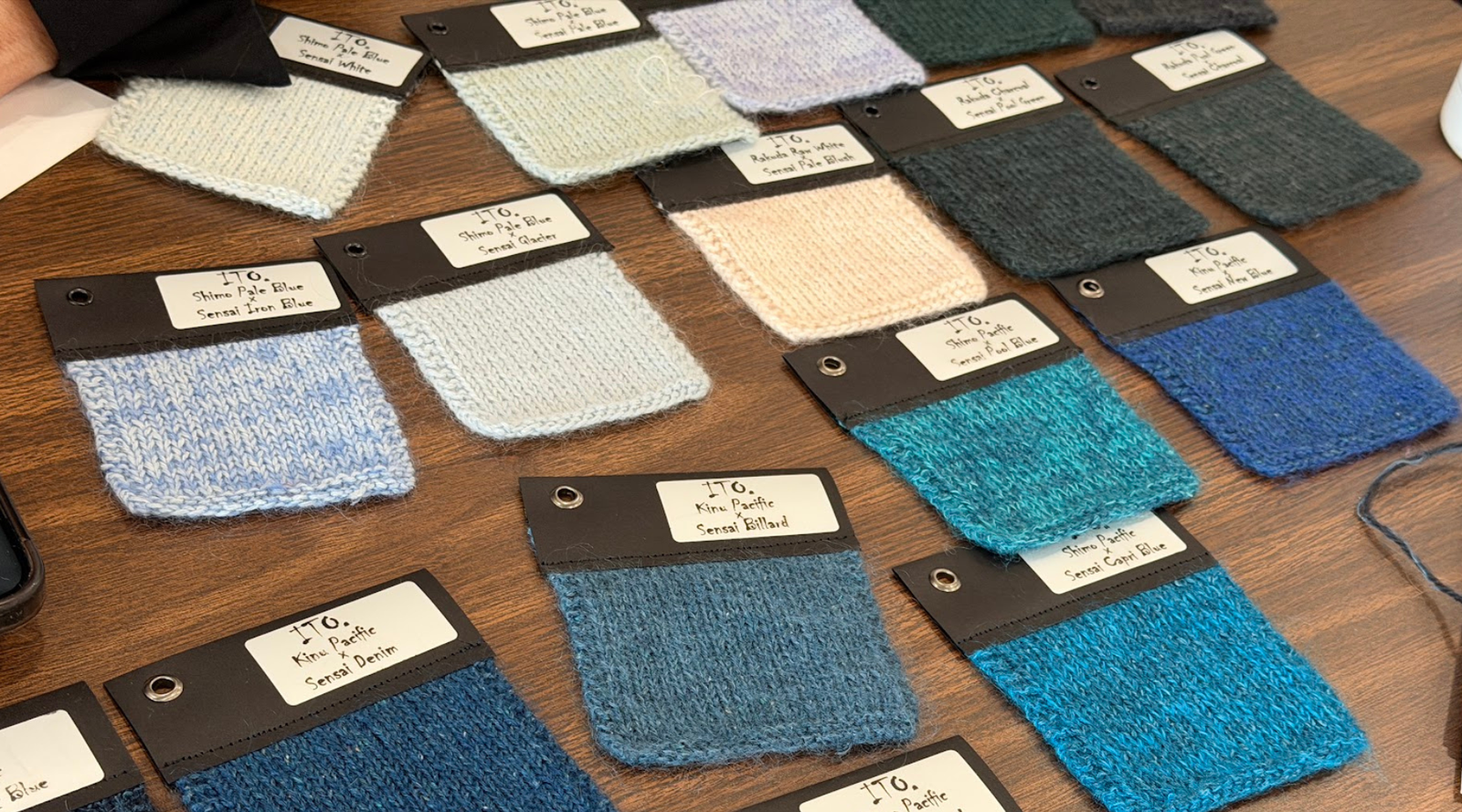
So we swatched. All weekend. Different fiber combinations on Friday, different color pairings on Saturday, watching how two colors sat next to each other and made something richer than either one alone. We were not swatching to see if we'd hit gauge. Nobody was counting stitches against a pattern's instructions, hoping the number would land. We were swatching to find the yarn combination and the needle size that gave us the fabric we wanted and a process that was pleasurable in our hands.

That's a different kind of swatch. When the swatch is the thing you came to make -- not the obstacle in front of the thing -- it becomes the whole point instead of the toll you pay to get started.

We could do this at home, you know. Any of us could clear an afternoon, pull out a few skeins, and just play -- no pattern, no deadline, no goal. Adjust the drape. See what the yarn wants to do instead of what we're telling it to do.
But do we?
No.
Because at home there's always something else. Dinner needs making. Errands need running. The house needs keeping. The pull of the pressing thing is strong, and creative play -- open-ended, goal-less, curious play -- rarely wins against it.
A retreat is quite literal, it turns out. We retreat. We step back from the things that are always pressing, and we make room for the things that never get room otherwise. And what we found in that room wasn't just information about yarn, though we found plenty of that. We found things about ourselves -- what fabric actually makes us happy to hold, apart from what a pattern told us to want. And we found each other. A room full of people who understand exactly why you'd drive from Chicago to swatch on purpose.

It's about the yarn, but it's not really about the yarn. It's about giving yourself permission to explore your craft without a finish line attached to it -- and about how much easier that permission is to find when you're not doing it alone.
In the framework I teach, this is Domain 8 -- the idea that Sustainable Practice needs room for play, not just production. Because sometimes you just need three days, some beautiful yarn, and people who are genuinely as interested in what you're discovering as you are.

-->
We have another fabulous retreat coming up in March, and if this kind of thing sounds like something you want more of -- not just a retreat twice a year, but an ongoing place to explore your craft alongside people who get it -- Club Crazy for Ewe opens its doors again next week. More on that soon.
Warmly,
~Ellen
Billie Mercer
July 14, 2026
Ellen, the retreat sounds like lots of fun. In the last photo what is the pattern for the pale blue? Gray? Blue-gray sweater at the near end of the rack. Looks like it might have ¾ sleeves. I’m interested in the Georgia Farrell pattern called Eve but I’d like to make it in black and white, with black as the main color instead of three colors as shown. Could it all be done in a sport weight yarn or do you think it would be better with the white in kid silk haze? I know that knitting with black is a challenge but it looks like it is all st st. I would not try to knit a patterned stitch sweater in black yarn! LOL
Wish I could have been with you at the retreat.
Billie