
Rowan Mohair Tweed Review: Not Tweed, Not Fuzzy, Not DK
Almost 40 years ago, I had a pair of dress slacks in a beautiful color, and I wanted a sweater to match. I was living in Northern California at the time, and when my mother came to visit, we stopped into a little yarn shop in Carmel called Knitting by the Sea. I found a skein that was exactly the color of those trousers -- I mean exactly -- and it turned out to be Anny Blatt Kiss, a luxurious blend of mohair, silk, and camel. It was beautiful!
That was my first exposure to mohair, and it wasn't fuzzy at all.
When I opened Crazy for Ewe more than 15 years later, mohair was all the rage. Classic Elite's La Gran, Plassard's Kid Mohair, and Rowan's Kidsilk Haze, as well as dozens of other laceweight varieties. They were all brushed to a fuzzy finish and looked nothing like that Anny Blatt mohair silk blend.
Until now.
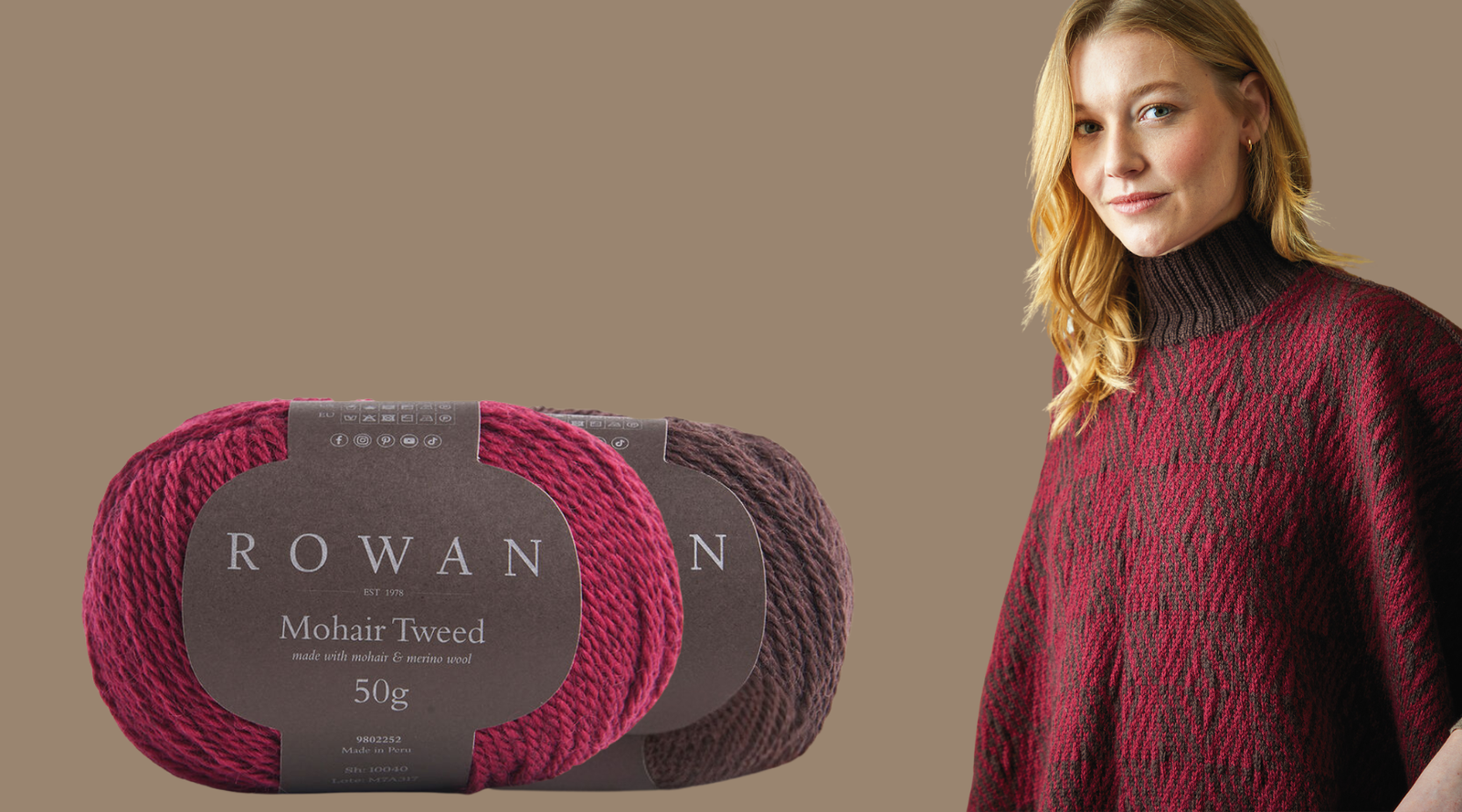
Rowan introduced a yarn this season called Mohair Tweed, with 70% merino, 30% mohair and no fuzz at all.
With so much mohair, why isn't this yarn fuzzy?
Mohair isn't naturally fuzzy, but if you're confused, you're not alone. In their raw state, mohair fibers are smooth and sleek and must be spun in a particular way and then teased to make them fuzzy. Since 90% of commercial mohair is brushed, it's easy to assume that "mohair" is synonymous with fuzzy.
What mohair actually does in a blend
Mohair fiber is considerably longer than wool fiber, and while it has scales, there are only half as many, and the scales it does have are very small and underdeveloped. Mohair fibers have less natural crimp than wool, so they lie flat and glide over one another.
That combination of characteristics does a lot of jobs, from adding luster and drape to improving durability.
Which brings us to this skein
Rowan's new Mohair Tweed is 70% merino, 30% mohair. This blend takes the very best of both fibers. Merino for softness and bounce and mohair for shine, durability, and drape.
But first, I was looking at the name. Mohair Tweed. This is definitely not a tweed. Tweed is traditionally a rustic-looking woolen spun yarn with tangled knots of fiber giving the yarn a noticeably textured, matte, and uneven look.
This yarn is the opposite of tweed.
Clearly worsted spun, Mohair Tweed has a smooth and polished look. Because of their varying scale structures, the two fibers take the dye differently. The mohair takes the dye with intense, vibrant brilliance, while the merino absorbs it with a richer, deep matte tone. Even though this yarn was dyed in a single solid color bath, it has beautiful micro-tonal depth and looks luminous rather than flat.
It is a sophisticated yarn.
It's also a three-ply yarn, which I love. Three plies twist into a round balanced strand with great stitch definition.
Will Mohair Tweed hold up?
A fair question with a luxury yarn. And my answer is:
Absolutely
In terms of raw strength and wear-and-tear, this yarn is a powerhouse. The mohair acts like structural reinforcement (almost like a natural nylon). It will withstand years of washing and wearing without thinning out or developing holes.
Pilling, or the lack of it, is an equally, if not more important aspect of durability, and I can tell you this yarn will not pill easily.
How can I be so sure Mohair Tweed won't pill? I'm so glad you asked.
First is the fact that it's worsted spun. Generally speaking, worsted yarns pill less than woolen spun because worsted spinning combs the fibers straight and aligns them in parallel before spinning, so there are far fewer stray ends left to poke out and tangle on the fabric's surface.
Second is the mohair factor. Mohair fibers are strong. They don't break under abrasion, so they won't snap to form the short broken fragments that typically feed pills.
And third is the fact that it's a 3-ply construction. Plies are like a mechanical trap that locks the fibers deeply into the yarn core, making it hard for friction to pull them loose.
No fuzz, luster, and durability. All good stuff. Now let's talk about the labeling.
Is the label a little misleading?
Mohair Tweed runs 109 yards to 50 grams. That works out to 2.18 yards per gram and scales up to 218 yards per 100g. That is the sweet spot for classic worsted weight yarn, and the exact yardage of Rowan Pure Wool Worsted.
The stated gauge tells the same story from a different angle. Twenty-one stitches to four inches is the very last stitch count still technically inside the DK bracket before you cross into worsted territory. Not comfortably DK. Barely DK.
I checked the obvious explanations before I trusted myself on this. It isn't fiber density. Mohair and wool weigh about the same: we've already established mohair and wool have about the same specific gravity: 1.32 for mohair and 1.31 for wool. (Yes, I checked it because I'm a yarn nerd.)
It also isn't a tighter ply twist as it is with Rowan Pure Alpaca. The ply twist on Mohair Tweed is slightly looser than the 3-ply yarn, Capsule, that I'm developing for the shop.
So, I'm not sure why they decided it was DK.
I once spoke with David MacLeod, Rowan Brand Manager, about how they decided the weight and appropriate gauge of a yarn, and he said they give the yarn to knitters in the office to swatch, and everyone says what gauge they like for it and what needle size they used. Then they put it all together and that's the gauge.
I guess that's probably as good a way to decide as any, given that these are all competent knitters. But from an objective perspective, this is a worsted weight yarn. Not Aran or heavy worsted, but classic worsted happiest at a gauge of around 20 stitches to 4".
So I was curious to swatch it.
What the swatches told me
Where would I start? I usually start a couple of needle sizes down from recommended which would be a US 4, but I decided on a 5.
On a US 5, I got 22 stitches per 4 inches, and the fabric was nice. Firm, but not too tight, and a pleasure to knit.
On a US 6, I got the 21 stitches predicted by the ball band. Again, nice fabric, and still a decent amount of structure.
On a US 7 I got 20 stitches over 4 inches, as I knew I would. The fabric still had structural integrity, but a tad more drape.
and finally, on a US 8, I got 19 stitches and a fabric that still had elasticity and recovery, the stitches remained even, and it had a bit more drape but still enough structure to hold up in a sweater.
Had I gone up to a 9, I suspect the fabric would have begun to lose its structural integrity and become floppy.

So what does this mean for you relative to the yarn?
It's about preference.
The British knitting community generally prefers tighter fabric in their knitwear for lots of reasons. They are more concerned with the longevity of a knitted garment, and more tightly knit garments are more durable. They're also warmer. Great Britain is cold, damp, and windy, so tightly knit wool sweaters are important pretty much all year long.
Here in the US, we have the luxury of knitting for fashion more than function, and the knitted fabrics we prefer reflect that.
The collection for Mohair Tweed
Rowan's own copy calls this collection "everyday knits... designed for warmth, comfort and effortless wearability." That's honest, as far as it goes -- it's a real description of what they built. But it's a choice, and I don't think it's the only choice this yarn supports. This yarn isn't tweedy. And to me, it isn't particularly casual. It's sophisticated. It's marled and lustrous and can drape but still hold its structure.
From the collection, I do love Portree, and I would absolutely knit it. Martin Storey's Glencoe Poncho in the low contrast colorwork is elegant, as is his Fortrose Cardigan in classic houndstooth. I also think the cute little Nairn Neckerchief is a perfect way to swatch this yarn and come out with something you can actually wear.
As far as the rest of the garments, they're very busy. On Ravelry, Georgia Farrell's Keiss, an all-over mosaic sweater, is the top pick, so what do I know? This is why it's so important to think about your own personal style and what is right for you rather than what I or all the other knitters on Ravelry think is fabulous.
Where I'd take it
Our next class in Club Crazy for Ewe is the Champagne Cardigan by Petite Knits.

I had considered this yarn for that sweater, and I swatched it with a strand of Kidsilk Haze. It's decidedly wonderful.
So that's one option.
I also think the Honey Cardigan would be gorgeous in it.
or for a nice elegant twist on this classic Breton sweater, the Lyon Sweater.
or this gorgeous cables sweater, the Book Club Pullover, where the yarn would make your stitches absolutely pop.
Honestly, this yarn is so pretty on its own, you could knit a simple stockinette sweater and just enjoy the heathery colors and beautiful stitches. Would love to hear what you decide. Tell me in the comments what you would make with Mohair Tweed.
Warmly,
~Ellen
p.s. Here's the sweater I knit with that Anny Blatt yarn. Still looking like new after almost 40 years. If that isn't a testament to mohair's durability, I don't know what is!

Joy
September 22, 2026
Great yarn review! I might make Toften by The Weststrand Sisters or Pemberton Pullover by Bobbi IntVeld with this yarn.
https://www.ravelry.com/patterns/library/toften—-mens-sweater
https://www.ravelry.com/patterns/library/pemberton-pullover