

The trick that solves the dropped shoulder problem
Last week I said you can have anything you want, but not everything you want.
I stand by that.
But it doesn’t mean you’re stuck. It doesn’t mean you have to accept whatever the construction hands you. It means you have to understand the construction well enough to build in what you actually want, before you cast on.
Ginni does this instinctively. She has been designing and knitting for longer than most people I know, and when she has a problem to solve, she solves it structurally. She doesn’t adjust after the fact. She thinks it through first.

The problem, if you read last week’s post, is this: in a standard dropped shoulder sweater, ease determines sleeve length. The body is a rectangle. However wide that rectangle is, that’s how far the shoulder seam sits from your natural shoulder point — and that distance becomes your sleeve. You don’t choose the sleeve length separately. You get what the ease gives you.
Which means if you want to go sleeveless in a dropped shoulder top, you have a problem. Bring in the ease, and you lose the sleeve. Keep the ease, and you have a stub — a little cap of fabric at the shoulder joint, not quite a sleeve, not quite a clean opening.
That is the tradeoff. And for most dropped shoulder patterns, it isn’t negotiable.
Ginni negotiated it, because of course she did.

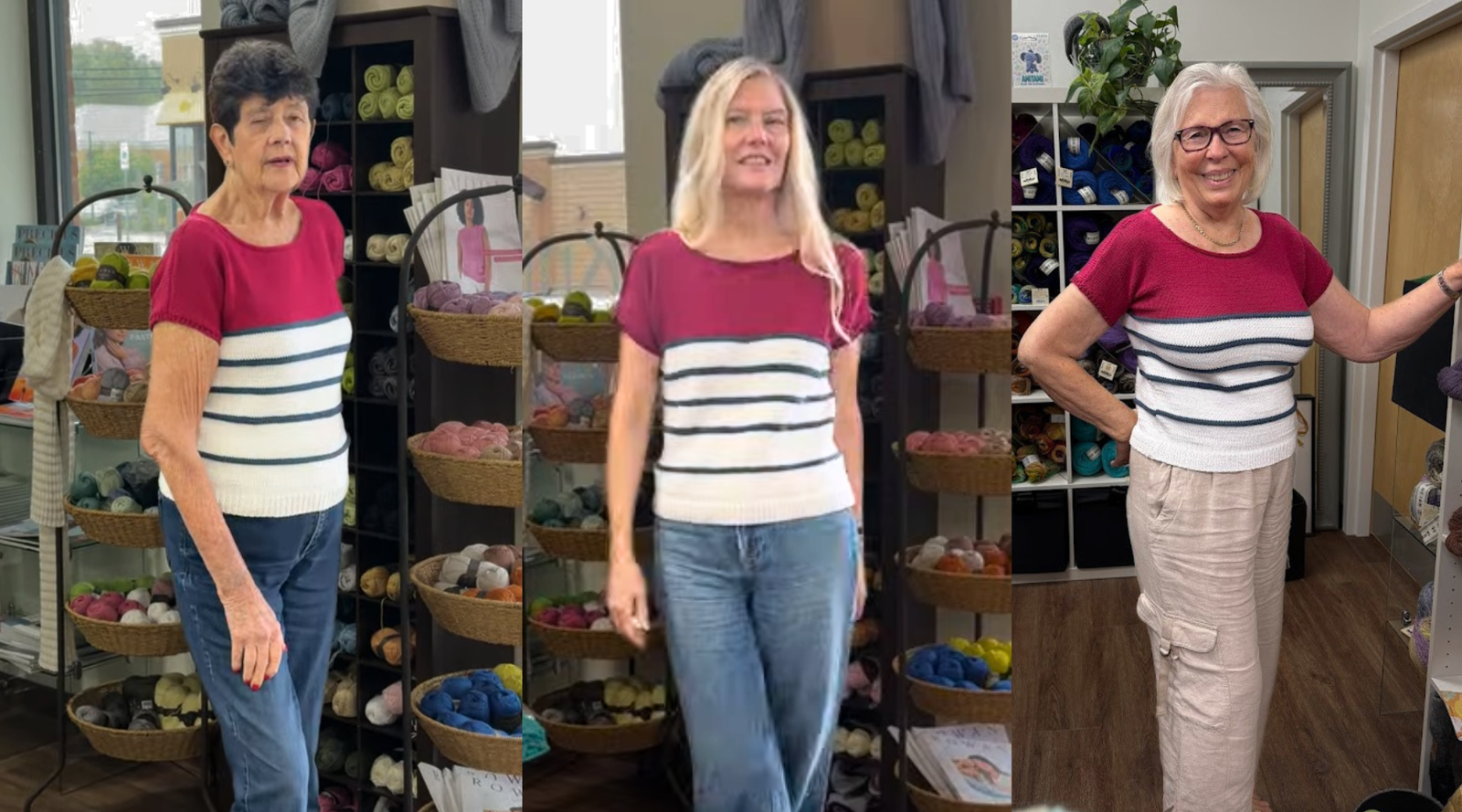
The Liberty 250 Tee is her design — a patriotic celebration of America’s 250th in red, white, and blue Rowan Summerlite DK, appropriately festive and genuinely lovely to knit. But what interests me technically is what she did at the armhole.
Instead of continuing the body straight up to the shoulder, Ginni added increases at the armhole area to create a smooth transition, then cast on additional stitches to form a cap sleeve. This separates the sleeve from the body. The ease in the body and the length of the sleeve are now two independent decisions.
You can have a relaxed fit in the body and still have a defined cap sleeve. You are no longer waiting to see what the ease hands you. You are designing both things, intentionally.

That is the trick.
It’s also not the only trick.
Ginni solved it by adding increases and casting on stitches to build the cap deliberately. But you could also work a deep angled armhole instead — gradual shaping outward toward the shoulder that gives you a slightly different silhouette and a bit more ease at the underarm. Same principle, different result. Or you could go in the opposite direction entirely, which is what we’ll look at next week.
What all of these approaches have in common is this: you understand what the construction is doing, and you decide not to simply accept what it hands you. You make a choice. You build in what you want.
The pattern is not the boss of you.
The body of the Liberty 250 still needs to fit you. The ease is now yours to choose, which means you have to actually choose it. Summerlite DK is 100% cotton — beautiful drape, very little stretch. It will tell you exactly what you put into it. Decide whether you want the fit to feel close or relaxed, then choose the size that gives you that.
What you have gained is agency. What you still have to bring is intention. How do you like things to fit? Now you can get that without sacrificing something else.
Next week we’ll look at a simpler modification — one small change at the armhole that solves the stub problem for a different kind of garment. Once you see what it does, you’ll start to understand why a little precision at the shoulder pays off in ways that go well beyond the seam.
The kit includes the pattern and enough Rowan Summerlite DK in the Liberty colorway to complete the project. Sizes run small through large here, and XL through 2XL here. If you have questions about sizing or fit decisions, that’s exactly what Flock Talks are for.
~Ellen
4 Responses


Laura
June 16, 2026
Would this work if you’re making a dropped long sleeve? I have narrow shoulders and drop shoulder construction often looks like I’m wearing shoulder pads.