
Why row gauge matters -- especially for raglan sweaters
I've knit hundreds of sweaters. I've taught countless knitters how to make sweaters that fit beautifully, and I have talked about the importance of gauge until I'm blue in the face.
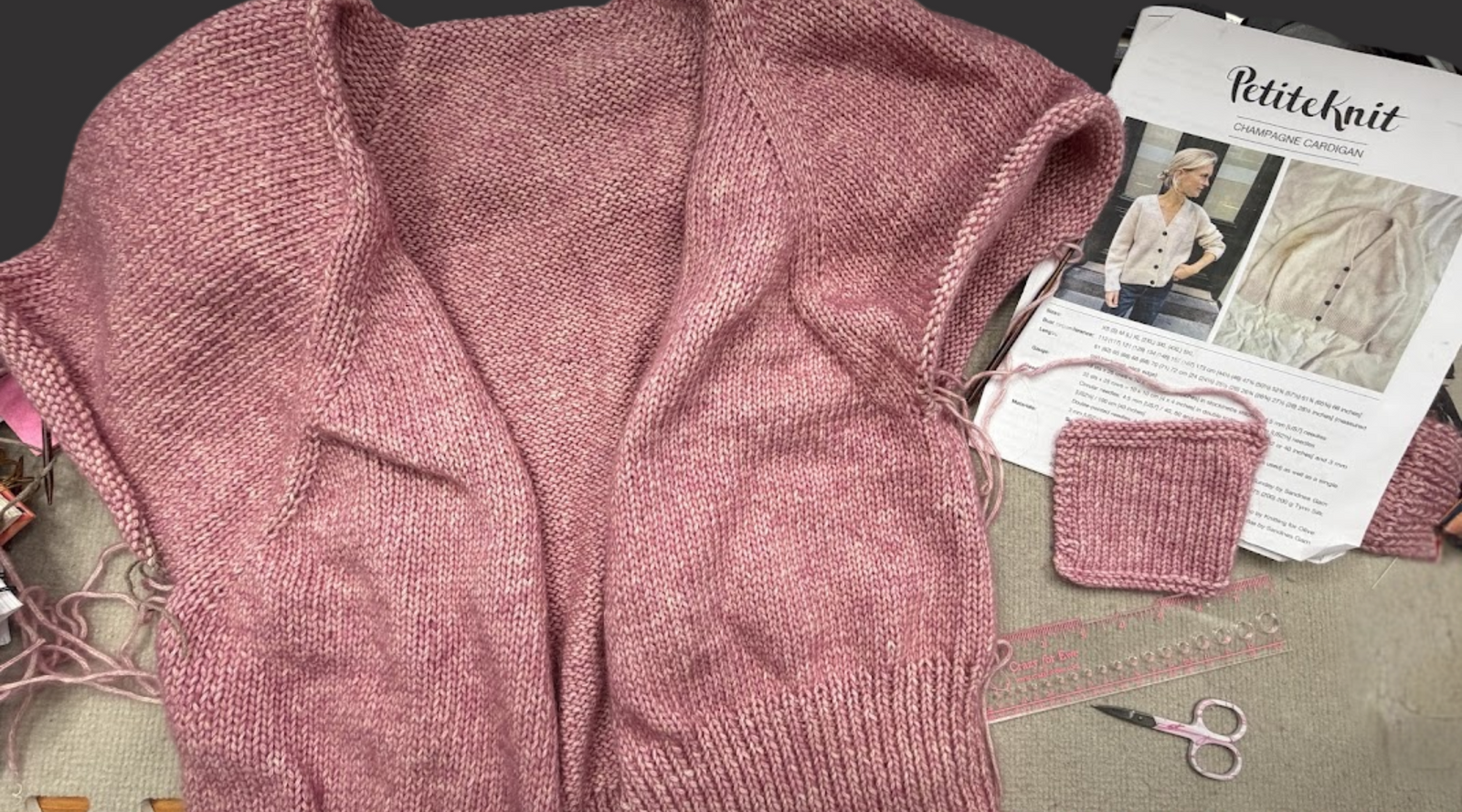
And yet, here I am, with a Champagne Cardigan that has slightly deeper armholes than I would have liked.
Why? Because I didn't follow my own advice.
Again.
I swatched. And measured carefully -- or at least I thought I did.
Here's the thing. I know my knitting. I know that when I'm knitting with a worsted-weight yarn on a US 8 needle, I get 18 stitches to four inches. Almost without fail.
So when I started swatching for my Champagne Cardigan and my swatch came out a little small, I did what most knitters would do. I went up a needle size.
Eighteen stitches to four inches.
Perfect!
I didn't check my row gauge.
You know I'm not a big raglan knitter. I've knit maybe 5 or 6 raglans, and they've all come out fine, but I knit more set-in-sleeve and drop-shoulder designs, where row gauge isn't always a very big deal. You do your shaping and knit until it's the right length. Who cares if it takes 60 rows or 65 rows to get there?
Row gauge doesn't really matter...until it does.
The button band gave me away
I probably wouldn't have noted my row-gauge problem if it weren't for the double-knit button band.
The Champagne Cardigan has an unusual double-knit button band that looks really clean and professional.
You work this button band in double knitting and attach it to the body as you go, and if the button band's row gauge is off, the band will either be too short and pull on the front edges or too long and ruffle. The designer doesn't go into all this, but she does tell you that the row gauge of the button band needs to match the row gauge of your sweater.
As I was swatching the button band looking for a gauge of 7 rows to the inch, I figured I might as well check the row gauge of the cardigan.
Mine was just over 6 rows to the inch.
Oops.
No wonder my armholes seemed a little deep.
Row gauge matters A LOT in a raglan
In a top-down raglan sweater, the increases happen over a certain number of rows. You can't get more increases without more rows.
And those rows determine how deep your armhole is.
If your stitches are taller than the designed gauge, the same number of rows give you more length and your armhole will be deeper than the pattern specifies. Which is exactly what happened to me.
Now, Champagne is an oversized cardigan. A generous armhole is part of its design, and I might never have given the extra depth another thought if the button band hadn't made me investigate.
Doesn't changing needle size change your gauge?
Of course it does. That's why we change needle sizes when we're swatching!
But here's something worth understanding: changing needle size affects both stitch gauge and row gauge, and not necessarily in the same proportion—or even in quite the same way.
It has as much to do with how you knit, how you tension your yarn, and how you form your stitches as it does with the needle size and the elasticity of the yarn.
When you change needle sizes, you're changing the amount of yarn that goes into forming each stitch. But that doesn't mean the stitch gets proportionally wider and taller.
A different needle might change your row gauge considerably without changing your stitch gauge very much at all.
Or it might not.
Which is why I always say, "Whatever the question, the answer is always Swatch it and see." I should have that tattooed on my arm.

I had swatched carefully and accurately. I just hadn't measured all the dimensions.
What if you can't have both?
When my first swatch came out a little small, I should have taken a closer look at both measurements.
Stitches and rows.
After all this discussion, I went back to that swatch on the US 8s and measured my row gauge. I counted about 14.5 rows over two inches which is very close to the pattern's 7 rows per inch. But the stitch gauge was 4.8 instead of 4.5.
I didn't calculate anything, I just went up a needle size.
I had options, but I didn't take the time to consider them.
In all fairness, it was the week before my daughter's wedding, and I wanted to take the project with me to California and get started. I was too hurried and distracted to evaluate my swatch beyond those 18 stitches to four inches.
I just thought I was good to go.
What I would do differently
I would take the time to calculate the impact of each of the gauges being off a bit. Here's what I mean.
The size I'm making (Medium) has 208 stitches around the stockinette body after you separate for the sleeves. At the specified gauge of 4.5 stitches and 7 rows per inch, those stitches give you 46.22" (not including the button band) and a finished bust of 47.75 with the button band. The raglan depth is 11.42", and the recommended ease is 11".
On the US 8 I was getting 4.8 stitches and very close to 7 rows per inch. My stockinette body would have measured about 43.3" plus another inch or two for the button band. That would have given me about 9" of ease -- enough, but not as much as the designer intended. And my raglan depth would have been much closer to the pattern.
On the US 9, I was getting the specified stitch gauge of 4.5 stitches, so my finished bust (before the button band) is 46.22, but at my row gauge of just over 6 rows per inch, the armhole is almost 13" -- an inch and a half deeper.
And here's another possibility I hadn't considered -- I could have knit the next size up (Large) at the tighter gauge which would have impacted my raglan depth by just half an inch compared with the inch and a half on the larger needle.
That might have been a really good compromise.
The point is, I had the opportunity to choose. We all do. A sweater is a system, and when we know and understand how it works, we can be intentional about our knitting and our results. But we have to take the time not only to swatch, but analyze, because that's how we get the fit we want.
That's what I'm always trying to help knitters achieve.
And it's why I believe so strongly that knitting a beautiful sweater involves more than following the directions. You have to understand how the garment is constructed, how the fabric behaves, and how one decision affects another.
So here's a bit of advice, from someone who really ought to know better:
Check your stitch gauge. Check your row gauge. Understand what those numbers mean for the sweater you're making.
Cynthia
November 17, 2026
A very instructive article. Raglans have always stumped me despite being an easy design. My front would always be baggier than my back and I realized I have a slightly rounded back and slopped shoulders that pitch forward. All this resulted in a raglan that looked horrible around the armhole when knitted according to the pattern and I couldn’t figure out the adjustment to make but your article has made me wonder if I need to check my row gauge. Thanks