

How 5 different designers use Noro Mebuki
The Noro Knitting and Crochet Magazine Issue 28 arrived the same week as the Mebuki, which felt like good timing. My first question is always - what are the designs for the new yarn. I was pleased to see six designs. Two accessories and 4 garments just for Mebuki. Like most Noro yarn, Mebuki has a strong color personality, which always makes it interesting to see how different designers handle the question they all have to address.
What do you do about the stripes?
Here's what I mean. Noro is not a variegated yarn — and that distinction matters more than most people realize. A variegated yarn jumps from color to color in short bursts. Your eye has to work to find a pattern. Noro uses long color repeats. The color shifts are gradual and intentional. The stripe is built in. On a scarf, that's a gift. On a shawl, it's beautiful. On a sweater body, it becomes a design decision — because horizontal stripes circle the torso, and they don't look the same on everyone.
The designers in this magazine knew that. Watching how each one handled it — or didn't have to — is actually a pretty good lesson in what it means to design with a yarn rather than just for one.
Shop all kits from Noro Magazine Issue 28 →
Down the Garden Path — Lori Steinberg

The scarf gets to sidestep the whole question entirely, and Lori Steinberg uses that freedom well. This is a small scarf with a delicate eyelet lace pattern — the kind of thing you could finish in a weekend and feel genuinely accomplished about. The shape will give Sophie Scarf knitters a familiar feeling, though the edge treatment here is a picked-up border rather than i-cord. Easy, pretty, and a lovely introduction to what Mebuki does with color in a narrow format. Down the Garden Path kit →
Interval Shawl — Melissa Leapman

A symmetrical triangle with an eyelet fabric and a cable running up the center spine. Classic construction, well executed. Here's a thought I had when I was looking at it — if you fold the collar back and add a clasp, this becomes a little capelet. Almost a jacket. Not quite a garment, but reaching toward one in a way that's genuinely appealing. For the knitter who loves the idea of a sweater but isn't quite ready to commit, this shawl will feel like a step in that direction. Two skeins. Interval Shawl kit →
Novice — Annabelle Speer

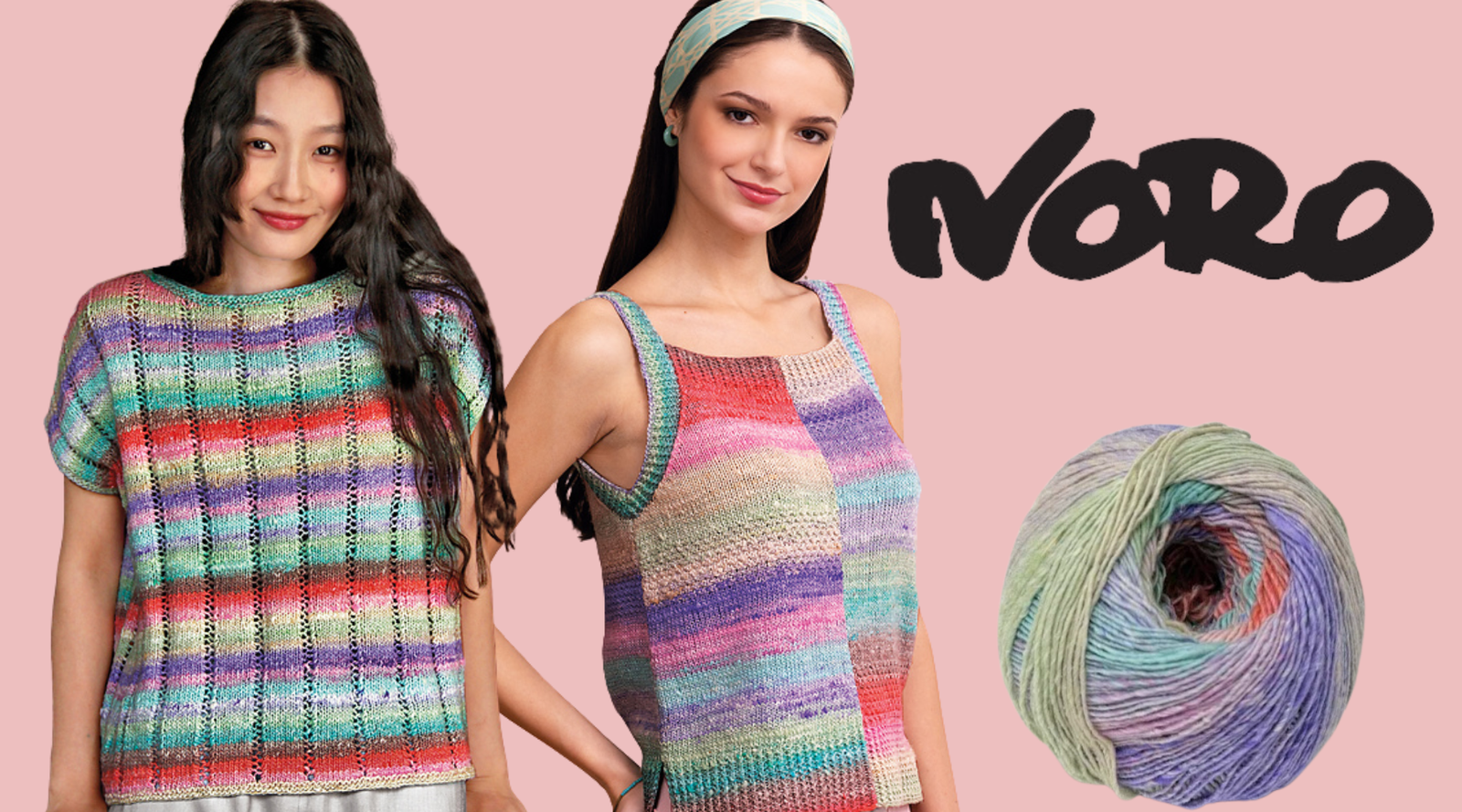
This is where we get to the garments, and I want to start here because this one makes a point I've been making for years. Sweater knitting does not have to be complicated. Novice is two rectangles sewn together. That's it. Annabelle Speer has added some simple extended garter patterning in the body and a bit of eyelet lace at the top, which gives it lovely detail, but the construction itself is as straightforward as knitting gets. It's a dropped shoulder sleeveless top, shown worn with slightly less ease than typical, which makes the sleeve section sit high on the arm.
When you're choosing your size, keep in mind that in a dropped shoulder garment, ease controls where the sleeve lands on your arm. Sizing up gives you more ease and a longer sleeve.
A beginner sweater that doesn't look like one. Two to three skeins. Novice kit →
Mistral — Noro Design Team

Another dropped shoulder sleeveless top, this one shown with considerably more ease — the sleeve section falls about halfway between the shoulder and the elbow, which gives it a completely different silhouette than Novice even though the construction logic is similar. That sleeve length is a function of ease. Sizing up gives you more ease and a longer sleeve — sizing down gives you less of both.
What elevates Mistral is the lace. Clean columns of a two-stitch pattern worked every row, run vertically through the fabric.
If you've been wondering how to use Noro on a garment without the horizontal stripe concern taking over, this is one answer: give the eye something vertical to follow. It works beautifully.
One note before you cast on. The pattern lists two skeins for every size. Trust me when I tell you that is not enough. The Mini-Break — a cami, smaller than this — takes three skeins for the largest size. Get three balls for the second size up and beyond. You will not regret the extra skein and you will absolutely regret not having it.
Two to three skeins. Budget three. Mistral kit →
Mini-Break — Sandi Prosser

Sandi Prosser has been designing for Noro since the early 2000s and it shows. This cami is doing several things at once without looking like it's trying.
The construction uses intarsia to create a color blocking effect — the yarn breaks directly down the center front, which means the two halves of the body are working from separate color positions in the skein. The result is an asymmetry of color that makes the garment look intentional and modern rather than striped. There's also texture placed in part of the fabric, which adds another visual layer to the asymmetric effect. The twisted rib hem is split for easy fit. The straps are worked as part of the armhole trim rather than added separately, which gives the whole thing a clean, contemporary finish. They appear to widen at the bust and narrow at the shoulder — I looked at the pattern expecting short rows, but it's actually just very clever decreases.
This is a cami that rewards a second look. Two to three skeins. Mini-Break kit →
Breeze — Noro Design Team

This is the one I keep coming back to.
Breeze is an oversized dropped shoulder pullover, and the Noro design team used intarsia here as well — but with a placement decision that's doing real design work. The color block break falls off-center rather than down the middle. It's not symmetrical. It sits in what feels like a phi relationship to the body — that golden ratio placement that your eye recognizes as pleasing before your brain can explain why. The result is bolder than a centered split would be, and more interesting.
The lace helps too. There's a ten-stitch, four-row pattern running through the fabric that gives a subtle vertical element. And here's something worth understanding about why that lace works so well with Noro specifically: because Noro is a long color repeat yarn rather than a variegated one, you're only ever looking at one color at a time within the lace pattern. Your eye doesn't have to jump around trying to reconcile multiple colors with a stitch pattern. The stripe is gradual enough that the lace reads clearly. It actually works beautifully.
Two to three skeins. Breeze kit →
Six designs, one yarn, and six different answers to the same question. The scarves and shawls get to enjoy Mebuki's color for what it is. The garment designers had to think about what the color does over a body — and the ones who thought hardest about it made the most interesting work.
~Ellen
Lynne Aikman
May 15, 2026
I love the Noro designs. Unfortunately in the UK there doesn’t seem to be anywhere to buy the latest Noro Magazines and the latest yarn, although I will keep looking. Thankyou Ellen for the Youtube videos and your amazing knowledge