

The Noro 28 Trunk Show and what surprised us
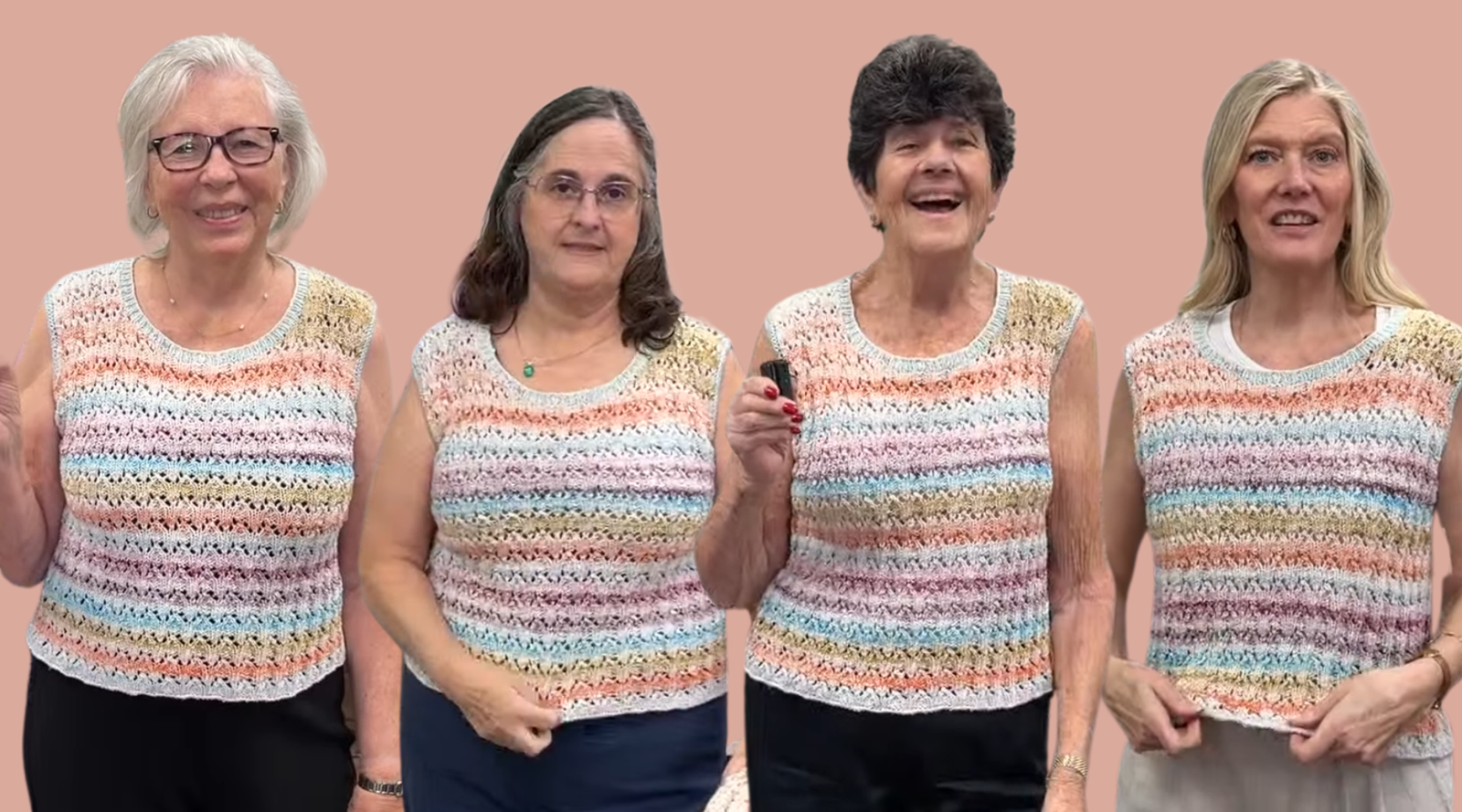
Four women. Twenty sweaters. A couple of hours in the shop.
First Lori and I tried everything. Then Mary and Ginni did while I observed. It takes a lot of time for four women to each try on every garment in the Noro trunk show. But it was worth it. We have four different bodies, four different style sensibilities, and four genuinely different relationships with ease and fit. We did not agree on much.
Except one thing.
The One That Worked for Everyone
The Neo-Classical Twin Set by Deborah Newton — a two-piece design from Noro Knitting and Crochet Magazine Issue 28, knit in Ohajiki. We all loved it. Not the set, but the shell. Sleeveless. Cropped. Lace. And despite its being in the most colorful Ohajiki, it was actually not too much. Every one of us put it on and liked what we saw.
I think when you get that kind of unanimous reaction it's worth examining, because it usually points to something structural rather than preferential.
The shell has a set-in sleeve construction. There is no actual sleeve — it's sleeveless — but the body is shaped the way a set-in sleeve body is shaped. The armhole is curved, and the fabric follows the natural line of the body, which is flattering whether you have a larger bust or not. It fit closely on some of us and loosely on others, but despite the difference in our bust size, the shoulder fit perfectly on all of us.
I have said for a long time that set-in sleeve construction is the most universally flattering of all the sweater constructions. This garment gives me four more data points to support that belief. It's not magic. But it is geometry. The shaped armhole does something that a dropped shoulder does not — it tapers. It doesn't rely on too much ease to create the sleeve. If you want a sleeve in a set-in sleeve top, you add one. You don't depend on the body being too big to create one. You get a defined fit without anything feeling too baggy or too tight. And on four different bodies, that definition reads as flattering every single time.
Here is the interesting part. The cardigan that Deborah Newton designed to go with that shell is a dropped shoulder. Same designer. Same outfit. And while we each found things to appreciate in the cardigan worn on its own, none of us loved the two pieces together the way the design intended. This is not a failure of design. It is a lesson in just how hard it is to layer handknits. I wish I could put my finger on the problem precisely. I think maybe the difference in gauge between the two pieces was not quite enough. I also think the two pieces sharing the same lace pattern were competing for attention. And I think there was a mood mismatch — the shell read summer playful and maybe a little festive, while the cardigan felt more serious and elegant. I love both pieces. Just not together.
What We Learned About Ease
Construction is not just about how a garment is made. It is about what it does to the body wearing it.
This is where it gets more complicated — and more instructive.
Mary found that the dropped shoulder garments with significant positive ease felt like too much on her. The volume was working against her rather than with her. On my frame, the same garments felt relaxed and easy. I did not experience them as too large.
This is not surprising once you understand what ease is actually doing. Positive ease adds fabric volume. How that volume reads depends entirely on the relationship between the fabric and the body underneath it. What reads as relaxed on one body reads as overwhelming on another. Neither reaction is wrong. Both reactions are information.
Lori's experience makes another really interesting point. There were garments she loved in the magazine photographs, all shown with positive ease. She would have automatically sized up before casting on. But when she tried on the samples, she liked how they looked on her body with negative ease. We are often afraid of negative ease, thinking it will look too tight. But the truth is that most of us wear garments with negative ease and never realize it. Sizing up as a reflex is one of the most common and costly mistakes knitters make. When we automatically size up, we're operating in what I call a fact-free environment — never considering how we actually like our clothes to fit.
The broader point is this. We think we know our preferences. What we actually know are our assumptions. And assumptions made from photographs are not the same as real intelligence about how your body responds to ease, how fabric volume reads on your frame, or how a particular construction works on your shape.
The Larger Lesson
What a trunk show gives you that a magazine photograph cannot is real information. How something actually sits on a shoulder. Whether the ease reads as relaxed or overwhelming. Whether the construction flatters or just fits. Whether the thing you thought you were going to love is actually the thing you love.
I thought I was going to love Breeze. I did not. I was genuinely surprised by how much I liked Novice, which is nothing more than two rectangles sewn together. It's shaped exactly like the very first garment I ever made, and it is not the long shapeless vest I keep making and giving away. It is a closer fit and versatile as either a vest or a top. And there happens to be this amazing pink Mebuki… just saying.
It can take a long time, but knowing what works for you and what doesn't is an essential part of sweater knitting success. It involves knowledge of all eight domains of sweater knitting — from understanding sweater construction styles and what they can and can't do, to creating a documented reference about what you like and what works for your body, to adjusting what doesn't work until it does.
That knowledge is available to you.
The trunk show runs through June 1st. Come try things on.
~Ellen
4 Responses


Kathy
May 20, 2026
Thanks – this is VERY helpful. I really enjoy these tips.